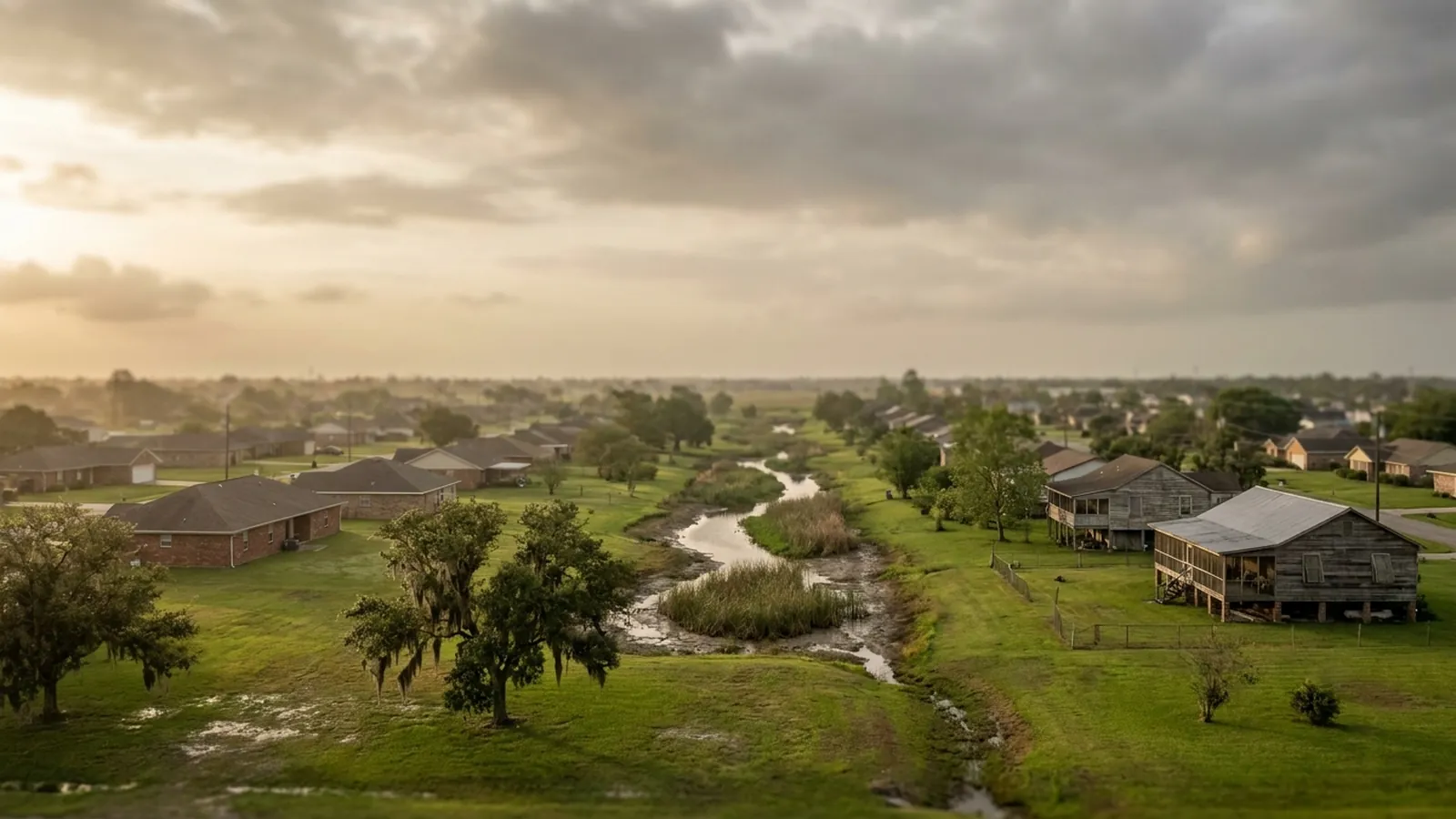
Helical piers in Lafayette cost $4,000–$15,000 for most full repairs, with piers commonly $1,200–$3,000 each. A push pier is driven using the building's own weight as reaction, and Acadiana's raised pier-and-beam stock does not provide enough of it — so a screwed pier is frequently the only workable option.
Why structure weight decides it here, what saturated ground adds, and how slab houses differ.
Weight decides it before soil does
A push pier is hydraulically driven using the structure above as the thing it reacts against. A raised pier-and-beam house — of which Acadiana carries a great deal — is simply not heavy enough to provide that reaction, so the pier stops advancing long before it has reached anything useful.
A helical pier is screwed in with a torque head. It does not care what the building weighs, which is why it is the standard answer under raised housing.
How a helical pier differs from a driven one
A push pier is hydraulically driven into the ground using the weight of the building as the thing it pushes against, until it refuses on something firm. A helical pier is screwed in, and the torque required to turn it correlates with the capacity it will carry — so it reports what it has found as it goes rather than only at the end.
That difference decides which is right far more often than price does.
What perched water adds
Crowley silt loam sits over a dense horizon that water does not pass through readily, and the prairie is too flat to shed it sideways. Ground that stays saturated loses bearing capacity, so the depth at which a helix finds competent material is a real question rather than a formality.
It is also why drainage frequently belongs in the same scope. Piers installed into ground nobody drained are piers working against a condition that is still there.
Slab houses are a different assessment
Post-war slab construction here can react against a driven pier and often does. Establishing which you own comes first, because the pier question resolves differently on each.
Helical piers, answered
What do helical piers cost in Lafayette?
$1,200–$3,000 per pier, most full repairs $4,000–$15,000. Pier-and-beam releveling runs $2,500–$9,000 where the structure is sound and only the support has moved.
Why can't push piers be used on my raised house?
A push pier uses the building's weight as the thing it drives against, and a raised pier-and-beam house does not weigh enough. The pier stops advancing before it reaches competent material.
Does the wet ground affect the piers?
It affects where competent material starts. Ground that stays saturated loses bearing capacity, so the depth a helix reaches is established per location rather than assumed.
Should drainage be in the same job?
Frequently, yes. Where a dense horizon is holding water under the house, piers alone leave the cause in place.
Is a helical pier the right tool for this ground?
Lafayette's ground has a floor in it — a dense horizon that perches water and keeps the soil above it saturated for long stretches. Steel that passes through that layer changes what the house stands on.
| Option | What it does | On this ground specifically |
|---|---|---|
| Helical pier | Screwed in until the torque proves the capacity | Torque-proven capacity beneath the perched-water zone — the right verification here |
| Push pier | Driven to refusal using the structure as ballast | The saturated upper soil weakens drive resistance readings — interpret with care |
| Pressed pilings | Precast sections pushed down and capped | Common in Acadiana for slab homes, with the same saturation caveat |
| Stabilise the soil | Manage moisture so the ground stops moving at all | Half of Lafayette's answer regardless of steel: the flat prairie cannot shed water sideways |
On raised pier-and-beam homes — a large share of the local stock — the right answer is often releveling rather than deep steel at all. The construction type decides before the soil does.
Book a free Lafayette site visit
The single most useful thing you can tell us is what your yard does after heavy rain — whether water stands, for how long, and in which corner. On this ground that observation narrows the diagnosis further than any description of a crack. Say whether the house is raised or on a slab too. Reply the same working day.