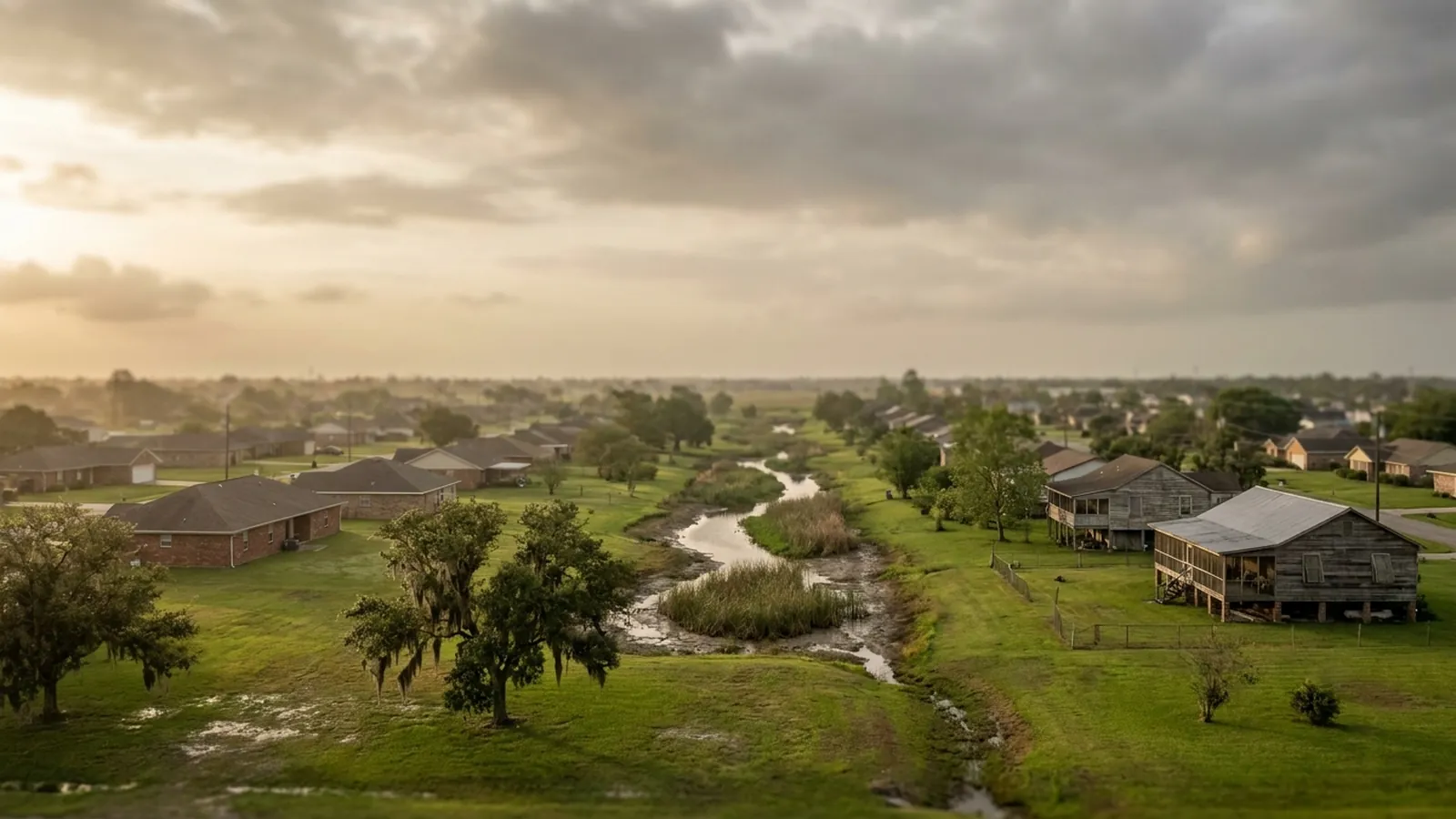
Foundation settlement repair in Lafayette runs $4,000–$15,000 for most full repairs. Crowley silt loam perches water on a dense horizon and the prairie is too flat to shed it sideways, so the soil supporting a foundation here spends long periods saturated rather than cycling.
Why this is the opposite of Baton Rouge, how raised and slab houses fail differently, and what the repair addresses first.
Water that perches instead of draining
The USDA maps Crowley silt loam across the Lafayette prairie at 18.6 percent clay and 59.1 percent silt at the surface, over a dense horizon that water does not pass through readily. At 60.50 inches of rain a year on terrain too flat to shed it sideways, the result is a soil profile that stays wet.
That is the opposite of Baton Rouge, 55 miles away, where Sharkey clay runs 84.3 percent clay all the way down. There the mechanism is shrink and swell; here it is prolonged saturation, and the two want different repairs.
Two housing stocks, two failure modes
Acadiana carries a large stock of raised pier-and-beam housing alongside post-war slab construction, and they do not fail the same way. Raised houses show sloping floors and bounce as piers settle unevenly into saturated ground, and are addressed by releveling with sill and joist work where the timber has suffered. Slabs show differential movement and cracking, and are addressed by underpinning where support has genuinely gone.
Establishing which you own comes before any of it, because the diagnosis reads differently on each.
What gets addressed first
The water, almost always. Where a dense horizon is holding water under a house, subsurface drainage changes the condition that is causing the movement — and steel installed into ground that stays saturated is steel working against a problem nobody removed.
The other thing saturated ground brings
The Formosan subterranean termite is the most destructive structural pest in Louisiana and has spread to 42 of the state's 64 parishes according to the LSU AgCenter. Damp timber in a raised crawl is what they are looking for, so on pier-and-beam properties the structural assessment and the insect question are the same visit. That page covers what we look for.
Settlement, answered plainly
What does settlement repair cost in Lafayette?
$4,000–$15,000 for most full repairs. Pier-and-beam releveling runs $2,500–$9,000 and french drains $1,500–$6,000 — and on many sites here the drainage is the line that decides whether the rest holds.
Why is Lafayette different from Baton Rouge?
Different soil entirely. Baton Rouge sits on Sharkey clay at 84.3 percent clay, which shrinks and swells. Lafayette sits on Crowley silt loam over a dense horizon, which perches water and stays saturated. Shrink-swell advice does not transfer.
My floors slope and bounce. Is that settlement?
On a raised pier-and-beam house it usually is — piers settling unevenly into ground that stays wet. Slab houses show it as differential cracking instead. Establishing which you own is the first step.
Should drainage come before piers?
Where a dense horizon is holding water under the house, yes. Steel installed into ground that stays saturated is working against a condition nobody removed.
Is the movement finished, and what does that change?
On the Lafayette prairie the failure mode is saturation: water perches on a dense horizon, cannot shed sideways on flat ground, and the soil above it holds a foundation in long wet spells.
| Option | What it does | What it means on this ground |
|---|---|---|
| Underpinning | Carries the load past the layer that is moving | Passes the load through the saturated zone to the dense horizon below |
| Void filling | Replaces ground that washed or compressed away | Less common here — the silt loam compresses rather than washes |
| Moisture control | Ends the wet-dry cycling that drives the movement | The prairie's real lever: get water off ground that cannot drain itself |
| Monitor first | Establishes whether the movement is even active | Track through a wet winter — movement that pauses in a dry autumn misleads |
Raised pier-and-beam homes settle differently from slabs and often need releveling rather than underpinning. Which house you own is the first diagnostic, before any soil question.
Book a free Lafayette site visit
The single most useful thing you can tell us is what your yard does after heavy rain — whether water stands, for how long, and in which corner. On this ground that observation narrows the diagnosis further than any description of a crack. Say whether the house is raised or on a slab too. Reply the same working day.